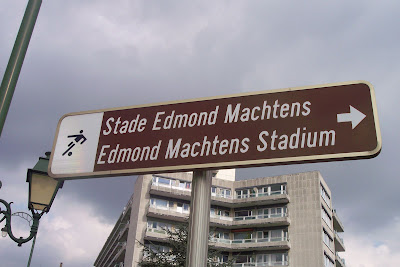
I returned to the stadium when I was back in Brussels on the Monday, & took some daylight snaps, so a number of these pictures will look almost identical.
On Facebook there is a 'Football Grounds in Brussels' group, run by a chap called Stephane Lievens. Here are his comments from there on the Edmond Machtens Stadium:
"Daring Brussels built their stadium here in 1920, moving from their home in Jette, as their ground was then too small to accommodate their many fans. At the time, the Daring Stadium was one of the most modern in the country and the national side used to play here. Daring won 5 league titles between 1912 and 1937. Back then, the rivalry with Union from bourgeois (at the time) Saint-Gilles was huge. It was the biggest event in Brussels before the war. In 1939, the stadium took the name of Stade Oscar Bossaert. Their fortunes having declined, Daring merged in 1973 with Racing White Woluwe, from Eastern Brussels, at the opposite side of the city (Daring had the money, the stadium and the fans, Racing White the team). The stadium took its present name and could host 32000 people and a new stand was build (the L'Ecluse stand, named after the then Daring chairman). The new club, Racing White Daring Molenbeek, in short RWDM, won their solitary league title in 1975. They too declined and in August 2002, folded and dissapeared. Personally, it was catastrophic as I have always supported RWDM since 1973... The big stadium was left vacant and in September 2002, KFC Strombeek, a club from a commune outside Brussels in Vlaams-Brabant playing in division 2, moved here. They changed their name for the 2003-2004 season into FC Molenbeek Brussels Strombeek but are more commonly known as FC Brussels. Today, the stadium's capacity is a little over 11000."
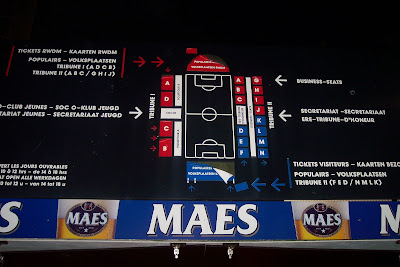
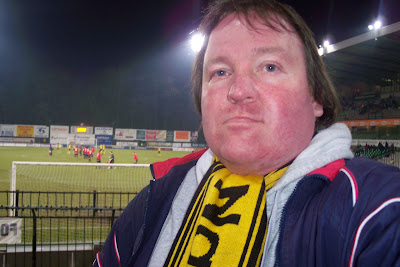
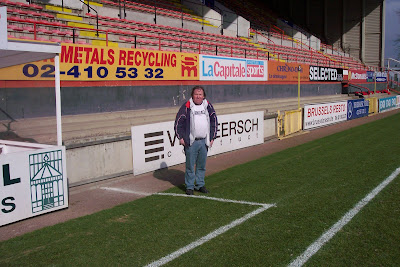
A rare 'self portrait' of my good self! I am in the open away end.
Here is the stand to my right, this is the Raymond Goethals Stand.

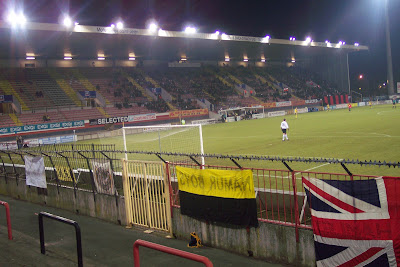
To the left is the L'Ecluse Stand. The main bulk of noisy home fans was down the far corner, you can see their red & black flag in front of them.
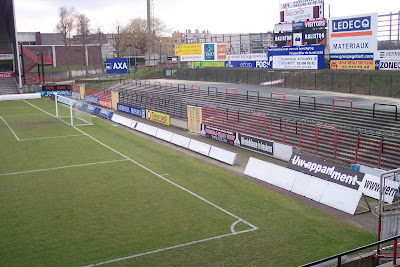
The far end is open, no spectators, just advertising boards.
Outside on a training field, I look back into the ground. Behind me is an area with no pitch markings, just a small, disused stand. We will see a shot of it later. Behind this stand, on the left, is an all-weather second pitch. There is a small stand alongside, but I was unable to get any photos of it.

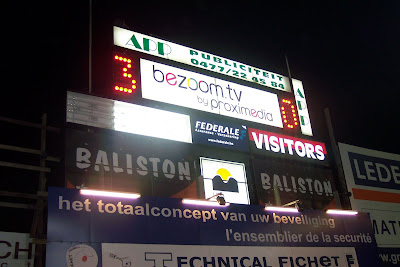
The scoreboard at half time, note somethig missing below the '1'...
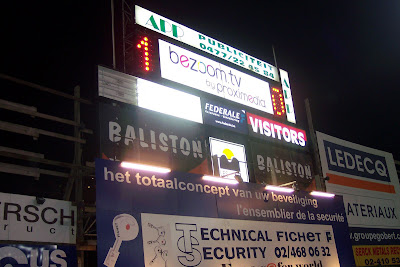
Ah, there it is!
Another look at the stand, from the corner of the away terrace.
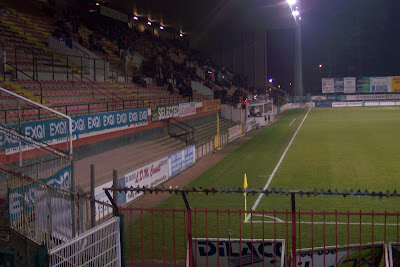
And across to the other one.

Here is a nice shot, along the terrace.
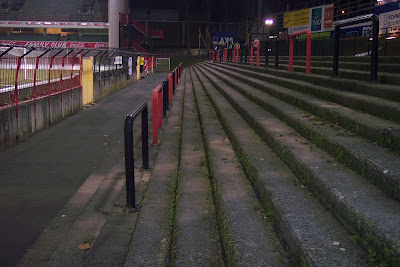
Well at least one travelling an from Namur seems happy! ;-)

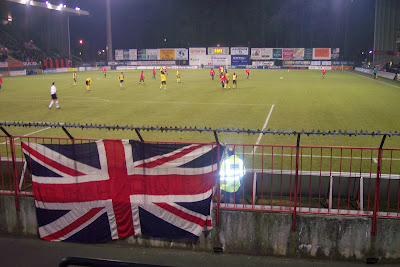
Looking across the pitch, with the game in progress.

Now two down, not long to go, as I take a picture looking up at the travelling support.

And turn to the lower section of the Goethals Stand.
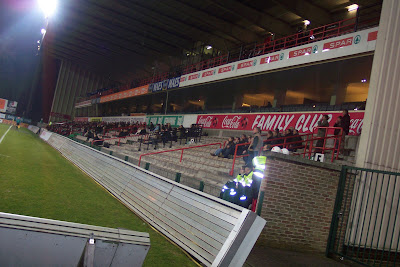
There's only about five minutes to go, so I leave the terrace & ask a steward if I can quickly go up into the stand to take some photos. She kindly agrees.
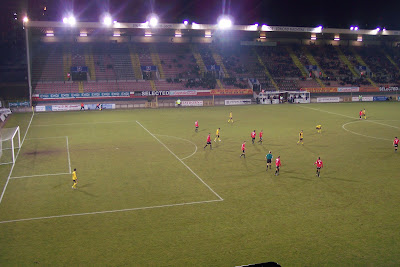
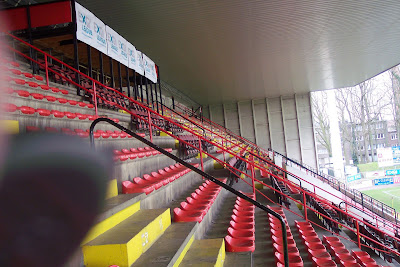
This is the Goethals Stand,upper tier.

And the lower section.

A view across the pitch.

And down to my left, my fellow away fans from Namur.
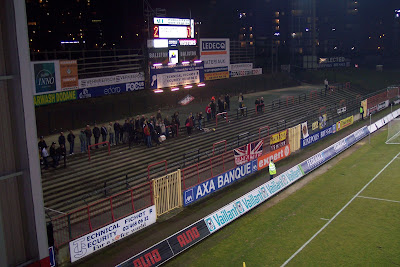
Final score, oh dear! Third division football next season!
The players come to show their appreciation to the loyal, long suffering away contingent.

Who continue to cheer their boys!

Now it is the Monday photos. The information on this stand taken, again, from the Belgian grounds Facebook group:
"The Raymond Goethals stand, built in 1993, replacing the beloved old Daring stand. It took its present name in 2005, after Raymond Goethals' death in December 2004. The famous Belgian coach began his career as a goalkeeper for Daring in the Thirties. He never coached any of the clubs here but was often spotted in the stands while not coaching his team."

This shows that there is nowhere for people to stand behind this goal.

I have entered the ground from the opposite end, to the terrace I was stood on, so the Goethals Stand is now on my left,
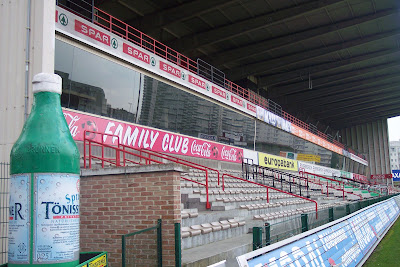
Here is a full length view of it.

Now, behind the goal, we face the L'Ecluse Stand.

Another look at it, with the small area of terracing in front, and the big home flag, which is clearly not taken home! I would've nicked it, but it would have been a bit too big for my wall at home! ;-)

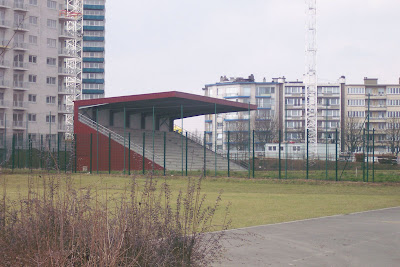
Here we look down the touchline, to the away end, with that strange, lonely stand behind it!
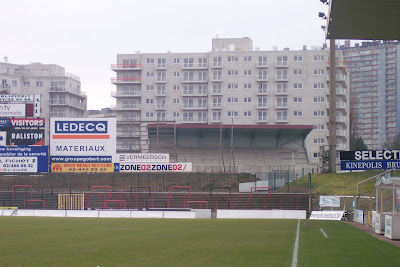
Here's another look at that stand, which I took later on, this is the closest I could get to it.
Back pitchside, another angle of the Goethals Stand.

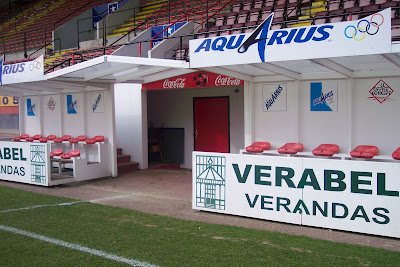
The dugouts.
Now we're up in the L'Ecluse Stand.

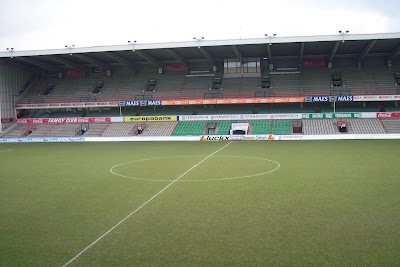
Looking directly across from the halfway line.
And down the stand again, whoops not the best of photos! ;-)
Moving along, we look down on the away end.
A good view of the terace in front. note the person walking past, a total stranger, also looking round, he offered to take my photo.

How could I refuse?
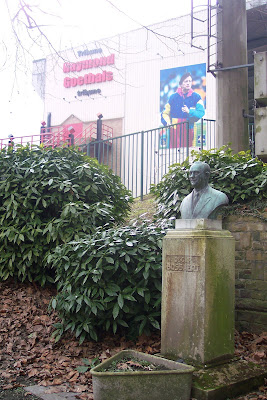
Now back outside, there is this bust of Oscar Bossaert, one of the first Daring chairman. The stadium bore his name until 1973. (Again, noted from the Facebook group)

Behind the 'empty' end are the main turnstiles.

Here is the L'Ecluse Stand, from the side.

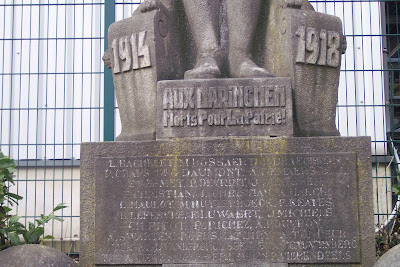
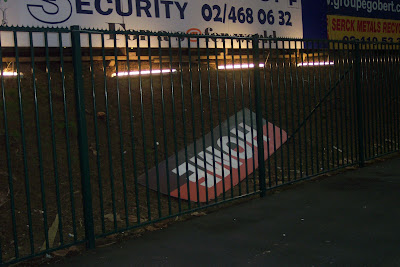
Before you enter the stand, to the right, is the Club war memorial,from the First World War. The loose, damaged panel at the front, remembers their members who fell in the Second World War.
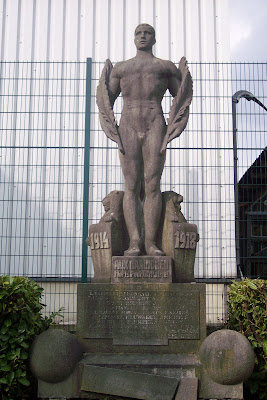
A close up of some of the detail.